
Haydon Hill Centre
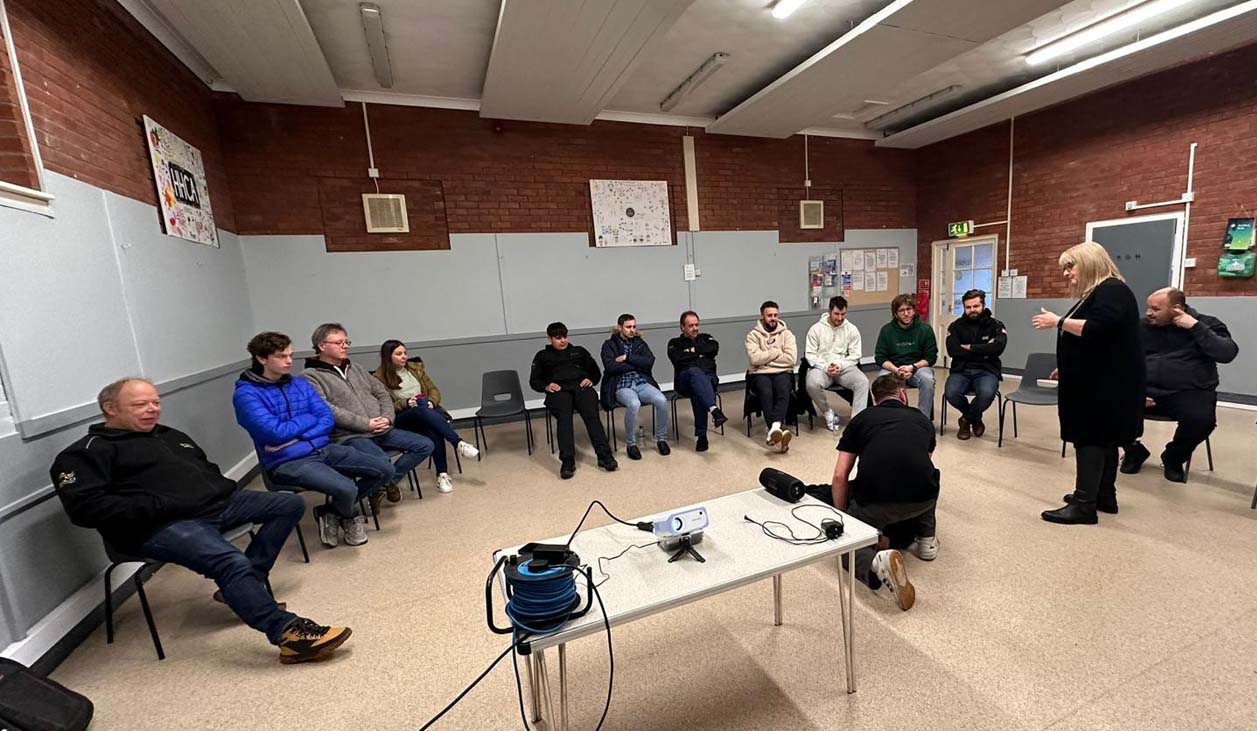
It was a small venue for such a big day and we were fortunate to secure it, fully booked for January, we took the last open slot. There were larger facilities available, including one in the centre of town managed by one of our clients. But just 5 minutes from head office, Haydon Hill Community Centre was clean, warm and just cosy enough to host our eventful day.
The agenda was tight, and the planned hour-long discussion on vehicle maintenance took a back seat on the day, because there was a pressing need to discuss some recent projects. In fact, at the eleventh hour we realised there wasn't enough time for all the planned training, and it was BS5839 updates that drew the short straw, as operatives would soon start training for FIA Fundamentals anyway. The backup modules, Working at Height Basics and An Introduction to Manual Handling, weren't needed either, and will surface on a rainy day soon.
We could have done with three days really, to cover all the prepared material, such was our desire to start the year off with a general grounding in basic Health & Safety. Eventually the right mix was settled on, and the training day was a success, as well as offering a rare opportunity for everyone to get together under the same roof.
"It was a structured day that included all of the modules that we thought were the most relevant. Basic First Aid was the main training that I wanted to give to our team as I believe it is essential that they know how to react in case of an emergency happening in the workplace."
— Elizabeth Walker
FORMS
The morning session started with a short video on some common forms familiar to all, such as the H-Certificates. The 'H' prefix is a legacy from the days when MW Fire were ISO (International Organization for Standardization) accredited, and the file names have remained ever since; the H has no other significance than that. These and other forms are scheduled to be revised sometime this year.
The talk on 'Forms' had a simple message: we all use forms to exchange information, and they exist to manage and make things efficient. It's a wonder that we so often need to be reminded to work tidily and employ good housekeeping, but these things pop up here and there, and much of it comes down to organising the paperwork.
A limited company is compelled to keep various financial and operational details for at least six years, to comply with the law. However, the majority of paperwork generated throughout the year is to provide evidence of Health & Safety for our clients. It also states our policies towards the welfare and rights of employees, the care of the environment, and the quality of our products, for the purposes of joining trade bodies and industry organisations such as ISO, BSI and SafeContractor.
Hopefully, the talk helped bridge a gap in understanding of our role in the lifecycle of a core form, such as an engineer's maintenance report or a Project Manager's installation certificate. Being knowledgeable and efficient pays dividends, as it leads to good results in the future when we need to provide insurance bodies, trade memberships and Health & Safety auditors with the right paperwork.
BASIC FIRST AID
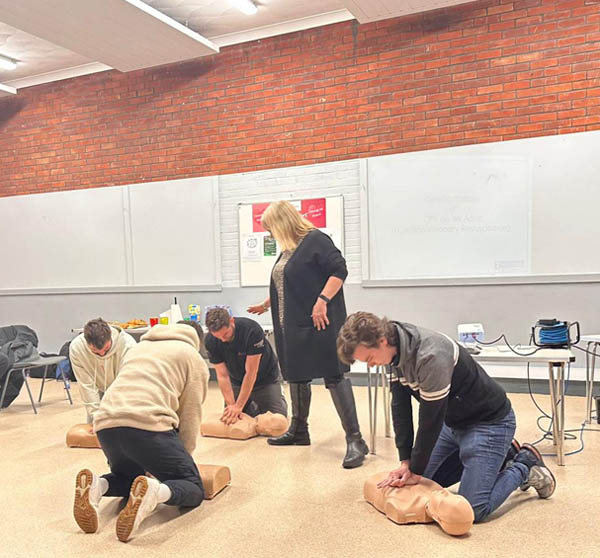
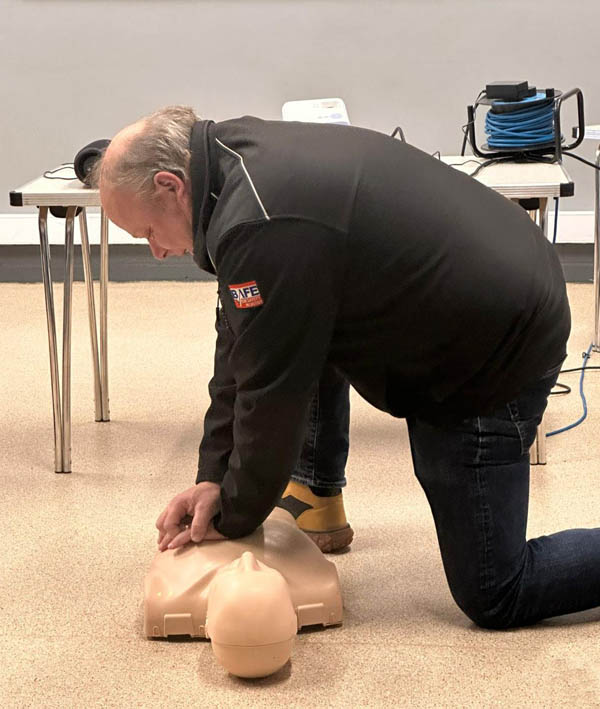
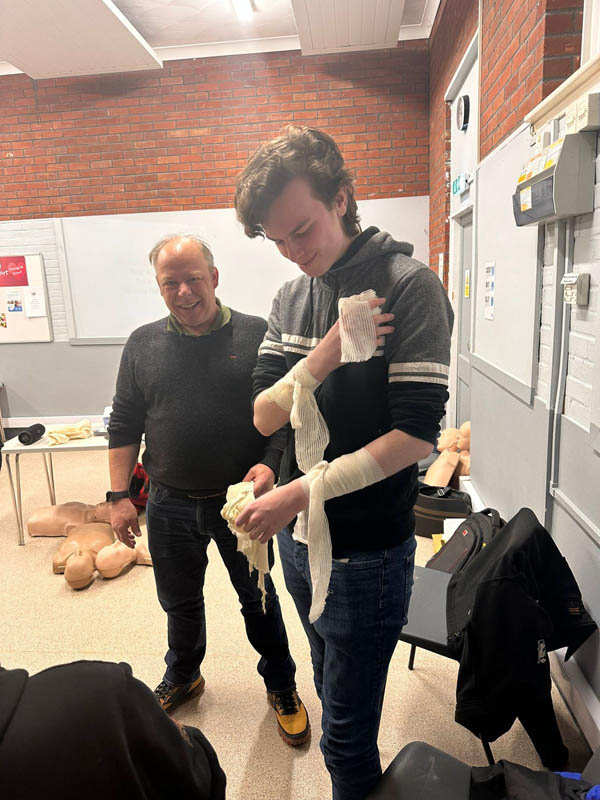
This was by far the most popular course of the day. It was presented by Jacqui from Trainingsmith, who tailored the session to provide plenty of hands-on practice.
"I was a St. John Ambulance cadet as a teenager, but it was a long time ago and there have been a lot of changes to the way things are done since then, and I'm quite glad I had the opportunity to have this training. I thought the course was quite comprehensive; the bit about heart attacks was particularly interesting."
— Darren Robinson

GDPR (General Data Protection Regulations)
Perhaps this topic was a little heavy going for an afternoon session, but it was nonetheless an important training module for obvious reasons. 'Obvious' because, like the earlier discussion about Forms, everyone in the company handles information in the course of their job, and there are legal obligations and ethical practices that determine how we should handle information about workers and clients with respect. Especially now, as privacy is slowly being eroded at every turn.
This course too was rather crammed, with all the items essential for a basic understanding of GDPR needing to fit into the 25 minutes allotted. Hopefully some, if not all, of the underlying messages hit home and something was learned from the presentation.
Asbestos Awareness (Refresher)
The main difference between this presentation and previous Asbestos Awareness training was that this one used a voiceover instead of just a series of slides with a multiple choice test at the end. As a refresher course, only the important points needed covering, which left room to slip in some real-world examples of asbestos in the workplace, with plenty of images, a video, and a closer look from the perspective of a professional asbestos removal company.
Some attendees hadn't done the full asbestos training yet, as the MWF Training website is still under development, but this refresher was comprehensive enough to satisfy auditors that they've received adequate awareness of asbestos in the workplace.
In conversations with some of the trade associations, we've found general agreement that much of the online asbestos training isn't up to scratch, often little more than 12 slides and a 5 question multiple choice at the end. For this reason we prefer asbestos awareness certificates to come from industry leaders such as RoSPA rather than just any approved centre. Ideally, though, we believe our own asbestos presentation is second to none, and would encourage anyone to take the MWF Training certificate, as it's far more comprehensive and harder to pass.
Feedback
Everyone had a copy of the agenda with a link to an anonymous Google feedback form. This is usually the kind of thing people don't bother with, typically only 10% will, if you're lucky. But feedback is a genuinely useful indicator of how things could be improved. If you found the day boring, there's no harm in telling us why, it'll help improve training and the experience overall in the long run.
Based on that, the prediction was 1.5 responses out of 15, so one or two replies were expected. Three came in initially, a 20% response rate, already above expectations. A final reminder from Elizabeth brought the total to 10, a 66.7% response rate. Thanks to everyone who took the time.
Let's take a look at what the feedback tells us.
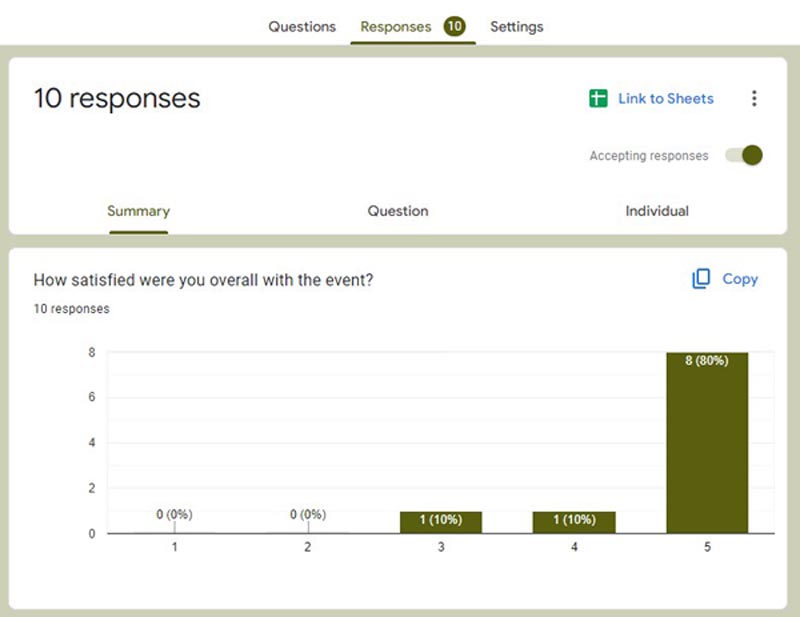
In the image below you can see the 10 responses. 8 out of 10 people enjoyed the day, with no one reporting a negative experience. That leaves 5 people who didn't respond at all, and we obviously can't know what they thought. But going on the responses we do have, it's reasonable to assume the day was well received overall.
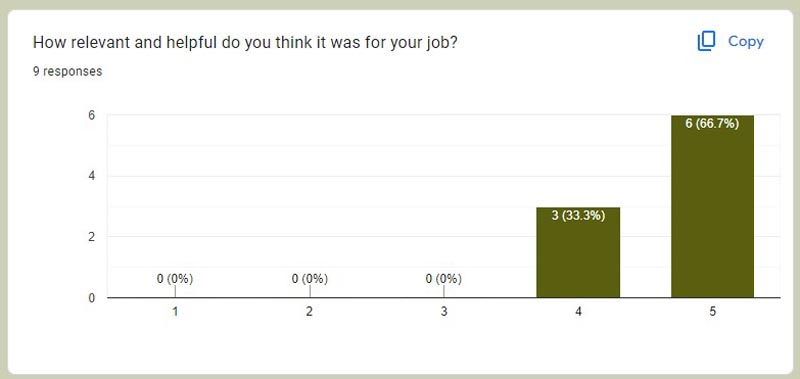
Now take a look at the relevancy chart below, which is the most significant indicator for us having put the courses together based on what we believed the most needed components were. In the image below we can see that the attendees were of the opinion that the material was relevant to them. Bear in mind that nobody knew exactly what was planned for the day until they first saw the agenda in the morning.
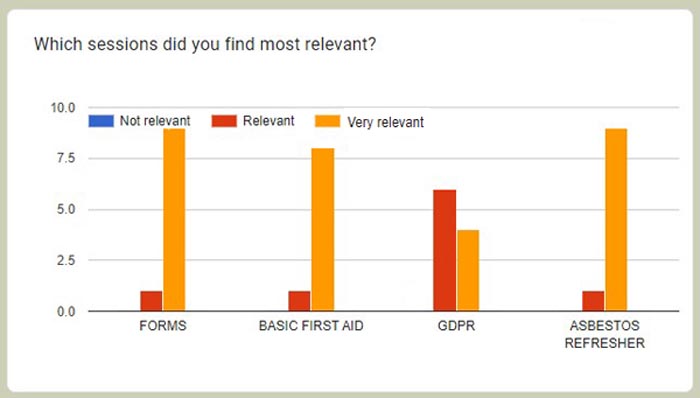
Another view on relevancy below, the most important thing. This bar chart does not tell what module was more popular, instead it looks at each module individually for relevance. It shows the sharp contrast between GDPR compared to the other modules.
We can see that all but one person agreed that modules were relevant, If it was the same person across the modules, then that person would appear to have not seen any relevancy in the Training Day at all. This is one reason why anonymous feedback is important so that this type of sentiment can be picked up and addressed.
Sometimes feedback reveals surprises. For GDPR, here we see only 4 people thought it was relevant to them and 6 people said it was not. It was in fact meant to be the main topic because Data Protection is so important, but the feedback reveals that we need to present this topic in an entirely new and engaging way.
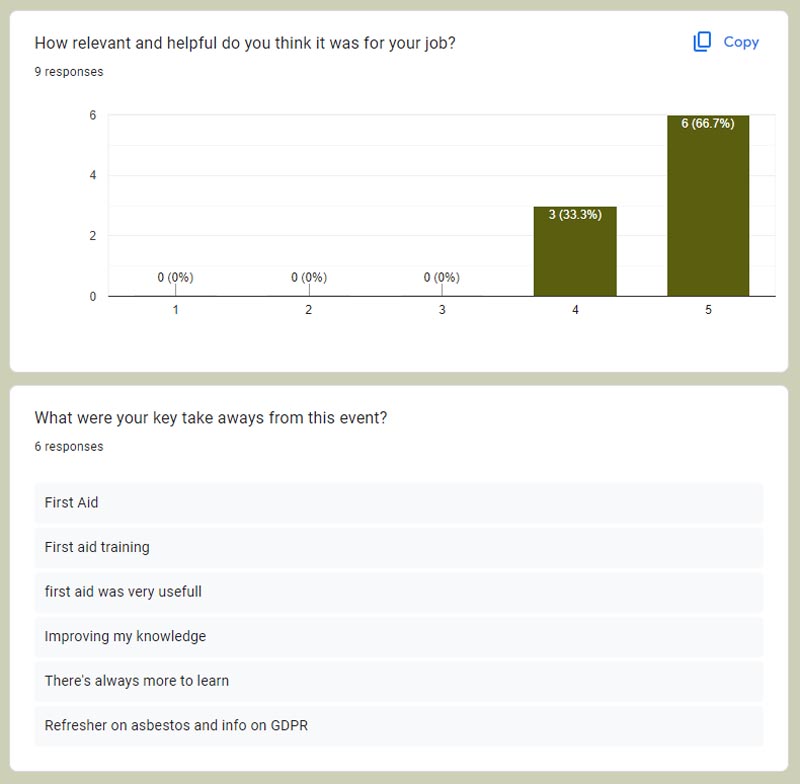
Overall, how helpful were the Training day modules and was there anything learned from them generally. See the two images below for the responses:
Any overall feedback for the event?
Here are a few of the final comments left at the end of the form:
- "Well worth the attendance"
- "Very satisfied"
- "Useful, GDPR not much interest from the rest and not sure if they understood, for office staff it made more sense, how it affects them directly."
- "The Data Protection part the lady spoke at times too fast. In the asbestos it said in the corner Part 4 and the next slide it was Part 3; one part it said a ffp3 mask is required and the picture was then shown with a man wearing a paper mask."
Thanks to everyone that provided feedback, as you can see, it was extremely helpful.
In Summary
The attendees for Training Day 2024 came from across the Company, so the training had to reflect this. It's to be expected that field operatives might not find GDPR very relevant to their day-to-day activities, just as office-based staff might not hold asbestos awareness in the same regard as operatives working on a CDM site.
This was the challenge: cramming as much as possible into every module, which actually goes against the principle of good presentation design, where it's usually better to be short and focused. This is something to address for future training.
For every training module, roughly 50% of attendees already held a certificate in that topic, with the rest hearing it for the first time. For GDPR, for example, that meant roughly 5-7 people already had a GDPR certificate, with 7-8 having no previous understanding of it.
As for feedback, as you saw above, it gave a fairly rounded summary of the day. It's safe to assume 14 people enjoyed it and 1 person didn't, and that most people didn't get on well with GDPR. As one comment put it: "the lady spoke too fast." As this was the first module of the day, the timing wasn't quite right yet, apologies for that, but the modules that followed had the pace slowed down, so hopefully those went better.
The asbestos course did indeed have the wrong part numbers in the top right corner of several slides. Thanks to the feedback, this has now been corrected, a bit too late for the day itself, but it means these things will be double-checked in future.
Regarding the discrepancy with the face mask type that was pointed out, was it about the image below?

The image was used from a website of the professional asbestos company where we grabbed the story. It does look like an FFP3 mask due to the nose clip and the protrusion for the mouth filter, however you may have meant that it should be an RPE respirator type.
As the MWF Training website develops, the goal will be to continue to make training simpler and easier to digest. If we don't succeed at making the experience enjoyable then maybe we can strive to make it more interesting.
